


Commercial Real Estate



Commercial Real Estate (CRE) is property, land, or buildings used exclusively for business purposes and to generate profit, either through rental income or capital appreciation (increase in resale value).
Unlike residential properties (owner-occupied houses or apartments), CRE is designed to support business operations. Investments in this sector are known to have high potential returns, but also carry greater risks and generally require larger initial capital.
5 Main Types of Commercial Real Estate
Commercial real estate falls into several main categories, each with unique risk and return characteristics:
-
Office Buildings
-
Description: Properties for rent for business operations, ranging from skyscrapers in the city center (CBD) to offices in the suburbs.
-
Example: Grade A, B, or C Office Towers.
-
Potential: Stable long-term (typically 5–10 years) rental income.
-
-
Retail Properties
-
Description: A building or space used to sell goods and services directly to consumers.
-
Examples: Shopping malls, strip malls, standalone shops, and kiosks.
-
Potential: Revenue depends heavily on local economic conditions and visitor traffic.
-
-
Industrial & Logistics Properties
-
Description: Facilities used for the manufacturing, production, storage, and distribution of goods. This sector is becoming increasingly important, driven by the growth of e-commerce.
-
Examples: Factories, warehouses, and distribution centers.
-
Potential: High and stable demand, especially for strategic locations near ports or toll roads.
-
-
Property Multifamily
-
Description: Although residential, properties consisting of multiple units owned by a single entity for rental purposes (rather than for sale individually) are classified as CRE.
-
Examples: Rental apartment complexes, student dormitories.
-
Potential: Offers stable cash flow due to domestic demand (housing needs).
-
-
Hotels & Hospitality
-
Description: Properties that provide short-term accommodations.
-
Examples: Hotels, motels, resorts, and guesthouses.
-
Potential: Highly volatile income, affected by tourism, seasonality, and global conditions.
-
CRE Investment Opportunities in Indonesia
The commercial real estate market in Indonesia, particularly in the Asia Pacific, continues to show positive growth. Some key opportunities in Indonesia include:
-
Industrial & Logistics Sector: This sector has become a key driver of investment due to increased manufacturing activity and the expansion of digital supply chains.
-
Integrated Area Development: Many large developers are focusing on developing areas that integrate residential, commercial (office/retail), and industrial spaces.
-
Tourism: Regions with high tourist attractions (such as Bali) are showing strong demand for hotel properties, villas, and supporting commercial spaces.
-
Supportive Regulations: The government continues to strive to simplify ownership and investment, including through land rights schemes such as Building Use Rights (HGB) for investors
How to Invest
Besides purchasing property directly, investors can also participate through:
-
Property Stocks: Buy shares in large property development companies listed on the stock exchange (e.g., CTRA, LPKR, BSDE).
-
Real Estate Investment Trusts (REITs): Collective funds that invest in a portfolio of income-generating commercial properties.
Key Risks
CRE investments generally have lower liquidity risk (difficulty selling quickly) and are highly sensitive to interest rates, economic conditions, and vacancy rates.
Real Estate Reseidensial

Residential real estate is the most common property category and refers to land and buildings primarily used as a residence for an individual or family.
This type of property is distinguished from commercial property (used for business) or industrial property (used for production).
1. Types of Residential Property
Residential properties include various forms of dwellings, depending on the location, size and structure of the building.
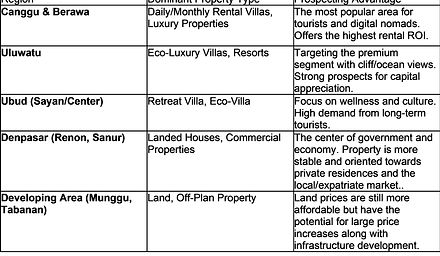
2. Latest Residential Property Market Trends in Indonesia (Outlook 2025)
The latest property market surveys and reports show interesting dynamics in Indonesia:
-
Limited Price Growth: Increases in the Residential Property Price Index (IHPR) tend to be limited (e.g., around 0.84% annually in the third quarter of 2025), indicating a stable but not overly volatile market.
-
Small-Size Buyer Interest: Sales of small-scale residential property units (such as modest homes or starter pack units) show positive growth. This contrasts with the limited contraction in overall sales in the primary market.
-
Government Support: Government policies, such as the extension of tax incentives (e.g., VAT DTP/Borne by the Government), play a significant role in increasing public access to housing, particularly for first-time homebuyers.
-
Dominant Mortgage Financing: The majority of home purchases in the primary market are made through mortgages (KPR), underscoring the important role of financial institutions in the property ecosystem.
-
Development Focus Outside Java: The buffer zone of the Indonesian Capital City (IKN) in East Kalimantan and areas supported by new infrastructure developments (such as the Trans-Sumatra Toll Road) are experiencing significant inventory growth.
-
Millennial and Gen Z Targets: 2025 is predicted to be bright with great opportunities for Millennials and Gen Z to buy homes, driven by equitable development policies and growth.